Short answer
- 31 minutes to Clark/Lake and 25 to the first Loop station, measured from the CTA schedule of 18 September 2026. The CTA publishes "20 to 25 minutes".
- $2.50, which is half the $5.00 O'Hare charges. That station carries a surcharge and Midway does not.
- The real difference between the two airports is 8.5 minutes, not the twenty the published ranges imply.
- The last train leaves Midway at 01:05 and the next is 03:30, or 04:30 on a Sunday. O'Hare's overnight gap is 20 minutes.
- Across 370 scheduled trips the journey varies by 0.5 of a minute. Rush hour does not change it.
01The short version
Take the Orange Line. It is $2.50, it takes 31 minutes, and it does not care what the traffic is doing. Midway is the easier of Chicago's two airports to arrive at and the fare is the main reason.
Unless you land after one in the morning. Then there is no train until half past three, and on a Sunday not until half past four. That is the one piece of information on this page that can cost you a night, and it is in section 04.
02The CTA's own estimate stops short
The CTA publishes "20 to 25 minutes" for this journey, and we repeated that figure ourselves in the O'Hare guide, citing them. Then we pulled the actual schedule.
What the schedule says against what the CTA says
| Minutes from Midway | |
|---|---|
| Harold Washington Library, the first Loop station | 25 |
| Clark/Lake, where this site measures to | 31 |
| What the CTA publishes in prose | 20 to 25 minutes |
Taken stop by stop from the CTA's GTFS schedule feed of 18 September 2026, read on 5 October 2026. Clark/Lake is the same station used to measure the Blue Line on the O'Hare page: measuring each airport to a different stop would make the two figures incomparable, which is the whole point of doing it this way.
Their range is not wrong, it is just measured to somewhere else. Harold Washington Library comes up at exactly 25 minutes, the precise ceiling of what they publish. Stay on to Clark/Lake, which is where the transfers are and where most people actually get off, and it is 31: 6 minutes past the top of their range.
A detail that makes this worth trusting more than a single reading. We measured all 370 scheduled trips, not one, and they run from 31 to 31.5 minutes. A spread of 0.5 of a minute across a whole timetable. The Orange Line does not have a rush hour, because it does not share its track with anything.
03Half the fare, and why
This is the part with money in it and almost nobody frames it as a comparison.
What the train costs from each airport
| From | Single fare | 1-Day Pass | What the pass is worth |
|---|---|---|---|
| Midway, Orange Line | $2.50 | $5.00 | Pays for itself on the second ride |
| O'Hare, Blue Line | $5.00 | $5.00 | Costs exactly the same as the single, so it is free extra travel |
CTA fares, read on 5 October 2026. The $5 O'Hare fare applies to that station only. Midway charges the standard L fare. The O'Hare arithmetic is the finding of our O'Hare guide: there, a single and a whole day of unlimited travel are the same $5.
O'Hare carries a station surcharge. Midway does not. The same network, a comparable journey, and one costs $2.50 more than the other. For two people it is the price of a coffee each; for a family of four arriving and leaving, it is $20.
The pass flips meaning between the two airports, which is the detail worth carrying. From O'Hare the 1-Day Pass is a free upgrade, because the single already costs $5.00. From Midway it is a genuine decision: $5.00 against $2.50, so it only makes sense if you are going to use the L again the same day.
04The gap at one in the morning
Midway takes late flights. The Orange Line does not wait for them.
Last train out, first train in
| Last departure | First departure | Hours with no train | |
|---|---|---|---|
| Midway, weekdays | 01:05 | 03:30 | 2 hours 25 minutes |
| Midway, Saturday | 01:05 | 04:00 | 2 hours 55 minutes |
| Midway, Sunday | 01:05 | 04:30 | 3 hours 25 minutes |
| O'Hare, any night | 02:50 | 03:10 | 20 minutes |
Counted from the CTA schedule feed of 18 September 2026, using only the trips that START at the airport, which is the only thing that helps someone who has just landed. Overnight trips run 00:00 to 02:50 every night, then the day service starts at 03:10.
Land at Midway at two in the morning and there is no train for an hour and a half. Land on a Sunday at the same time and it is two and a half. At O'Hare the equivalent wait is 20 minutes, because the Blue Line runs overnight services that the Orange Line does not.
This nearly went out wrong, and the reason is worth saying. The first time we counted, both lines appeared to run from 3 a.m. to 11 p.m. and neither to run overnight. That was an artefact of our own filter: the CTA keeps its late-night service in separate schedule patterns of five to twelve trips each, and we had kept only the largest pattern for each line. Published as it stood, it would have told you the Blue Line stops at night, which is false.
If your flight lands in that window, the train is not a choice you have. The practical options are a taxi from the rank or a car booked in advance, and the one below is the only Midway transfer in our catalogue with a meaningful number of reviews behind it.

Runs when the train does not
Private transfer, Midway to a Chicago address
3.48 · 54 reviews
Here because it is available 24/7 and the Orange Line is not, which is the only situation where a $50 car beats a $2.50 train. Its own listing states all fees and taxes are included and gives 60 minutes of airport pickup time, which matters on a delayed late arrival. Three things we would want told to us before booking: 3.48 from 54 reviews is the weakest score in our whole Chicago catalogue, the operator field on the product record reads Elife Las Vegas, which is a Las Vegas company selling a Chicago transfer, and meet and greet is listed under exclusions rather than inclusions.
05Midway against O'Hare, measured the same way
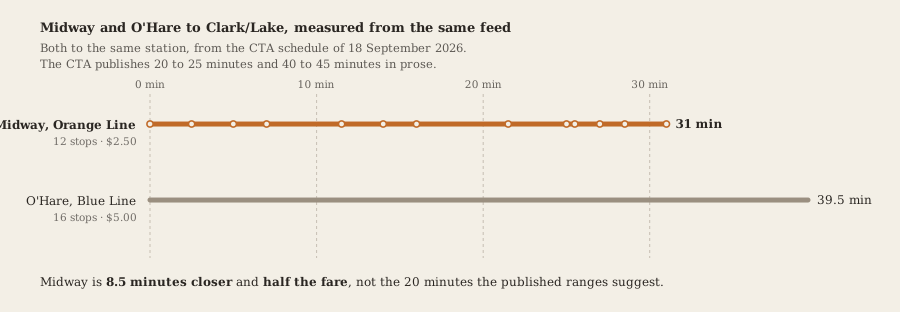
8.5 minutes and $2.50. That is the whole of it, and it is a smaller time gap and a bigger money gap than the usual framing. Setting the CTA's two prose ranges side by side, 20 to 25 minutes against 40 to 45 minutes, suggests Midway saves you something like twenty minutes. Measured to the same platform, it saves 8.5.
Where Midway loses is the night, and where it wins is the fare and the fact that the Blue Line journey from O'Hare runs for 62 per cent of its length within 150 metres of the motorway, which is a different kind of trip. Both are better than a car for the same reason: they cannot be delayed by traffic.
06Stop by stop
The Orange Line from Midway, minute by minute
| Stop | Minutes from Midway |
|---|---|
| Midway | Departure |
| Pulaski | 2.5 |
| Kedzie | 5 |
| Western | 7 |
| 35th/Archer | 11.5 |
| Ashland | 14 |
| Halsted | 16 |
| Roosevelt | 21.5 |
| Harold Washington Library | 25 |
| LaSalle/Van Buren | 25.5 |
| Quincy | 27 |
| Washington/Wells | 28.5 |
| Clark/Lake | 31 |
From the CTA schedule feed of 18 September 2026. The two highlighted rows are Harold Washington Library, the first stop in the Loop, and Clark/Lake, the station used to compare with O'Hare. Station names are printed as the CTA publishes them, with the line suffix removed: the feed calls them Pulaski-Orange and Western-Orange to tell them apart from stops of the same name on other lines, and on this stretch there is nothing to confuse them with.
Departures towards downtown, hour by hour
| Hour | Departures |
|---|---|
| 03:00 | 2 |
| 04:00 | 5 |
| 05:00 | 6 |
| 06:00 | 11 |
| 07:00 | 8 |
| 08:00 | 12 |
| 09:00 | 7 |
| 10:00 | 7 |
| 11:00 | 7 |
| 12:00 | 7 |
| 13:00 | 7 |
| 14:00 | 8 |
| 15:00 | 8 |
| 16:00 | 8 |
| 17:00 | 6 |
| 18:00 | 6 |
| 19:00 | 6 |
| 20:00 | 5 |
| 21:00 | 5 |
| 22:00 | 4 |
| 23:00 | 4 |
Counted from the same feed, weekday service. This is the schedule rather than the "every ten minutes" that gets repeated, and the difference between hours is large enough to matter if you are leaving early or late.
07Questions people actually ask
How long does it take to get from Midway to downtown Chicago?
31 minutes on the Orange Line to Clark/Lake, measured stop by stop from the CTA's own schedule feed of 18 September 2026. The CTA itself publishes "20 to 25 minutes" in prose, which is accurate only to the first Loop station: Harold Washington Library comes up at exactly 25 minutes. Carry on to Clark/Lake, which is where most people are changing or getting off, and it is 31.
How much is the train from Midway to downtown?
$2.50, the standard CTA fare. This is the single biggest difference from the other airport: O'Hare charges $5.00 because that one station carries a surcharge, and Midway does not. The same network, the same kind of journey, half the price. A 1-Day Pass is $5.00, which means from Midway it pays for itself on the second ride and from O'Hare it costs exactly the same as the single.
Is Midway closer to downtown than O'Hare?
Yes, but by less than the published numbers suggest. Measured to the same station from the same feed: Midway 31 minutes, O'Hare 39.5. That is a difference of 8.5 minutes. Comparing the CTA's two prose ranges, "20 to 25 minutes" against "40 to 45 minutes", implies a gap of roughly twenty. The money is the real difference: half the fare.
Does the Orange Line run all night?
No, and this is the thing worth knowing before you book a late flight. The last train out of Midway is 01:05 and the first is 03:30 on weekdays, 04:00 on Saturdays and 04:30 on Sundays. That is a gap of 2 hours 25 minutes to 3 hours 25 minutes with no train at all. The Blue Line at O'Hare runs through the night and its gap is 20 minutes.
How many stops is it from Midway to the Loop?
12 stops to Clark/Lake, with Harold Washington Library the eighth and the first one in the Loop. The line is above ground almost the whole way, which is worth knowing if you want to see where you are going rather than a tunnel wall.
Does the journey take longer at rush hour?
Essentially no, and that is unusual enough to be the reason to take it. Across the 370 scheduled trips we measured, the Midway to Clark/Lake run varies by 0.5 of a minute: from 31 to 31.5. The train has its own track and does not sit in traffic. A car on the Stevenson at 5 p.m. is a different proposition, and nobody can publish a figure for that in advance.
How often does the Orange Line run?
Up to 12 departures an hour at the busiest times, falling off in the evening. The full hour-by-hour count is in the table above, taken from the schedule rather than from the "every 10 minutes" that gets repeated.
Is a taxi or Uber better from Midway?
It depends entirely on the hour. Between about 1 a.m. and 3.30 a.m. there is no train, so it is not a comparison. Outside those hours the train is $2.50 and immune to traffic, which the road is not. We have not published a taxi figure for Midway because we have not measured one: the Chicago meter changed on 1 July 2026 and the estimates still circulating predate it, which is a trap we walked into on the O'Hare page and corrected.
 Diego Fresno
I flew into O'Hare in July 2025, not Midway, so I have not ridden the Orange Line. That is why this page contains no account of what the trip feels like and a great deal of arithmetic instead. Everything here comes out of the CTA's own published schedule, which is a file anyone can download and almost nobody opens. The overnight gap is the part I would want to know, and I nearly got it wrong: my first count said neither line runs at night, which was my filter rather than the CTA's timetable.
Journey time, stop sequence, departures by hour, the 370-trip spread and the first and last departures from the airport all computed from the CTA's GTFS schedule feed dated 18 September 2026, read on 5 October 2026, cut at Clark/Lake to match the Blue Line measurement on the O'Hare page. Fares from the CTA. The CTA's own prose estimates quoted from transitchicago.com. Transfer price, rating, review count and operator from the Viator product record, with the operator taken from the record rather than the title. NOT verified and therefore absent: what a taxi or rideshare costs from Midway, which we have not measured and will not estimate, particularly since the Chicago meter changed on 1 July 2026 and most figures in circulation predate it; and whether the trains run to schedule, which a timetable cannot tell you.