Short answer
- Take the train, and buy the day pass rather than the single ride. Both cost $5. One of them is also valid for the next 24 hours.
- Two City of Chicago bodies publish different taxi estimates for the same trip: the CTA says around $40, the airport says an average of $50.
- Both are below what the city's own meter rate now produces. Chicago's taxi fares rose on 1 July 2026, the first change since 2016, and two surcharges appeared that did not exist before.
- The train's 45 minutes is a ceiling. Every road option is quoted at 25 to 90 minutes, so the car is faster at best and far slower at worst.
- Taxis are directly outside baggage claim. Rideshare pickup is upstairs, at Terminals 2 and 3 only.
01The short version
Take the Blue Line. It leaves from inside the airport, it runs at every hour of every day, and it costs less than a tenth of the alternatives. The case against it is luggage, small children, or a hotel that is not near a station, and those are real reasons rather than excuses.
If you are taking it, buy a 1-Day Pass and not the single ride. That one decision is the most useful thing on this page, and it is explained in section 03.
If you are taking a car, the number to have in your head is not the forty dollars that the guides repeat. It is closer to sixty, and the reason for the gap is a rate change in July 2026 that almost nothing written about this trip has caught up with.
02The four ways in
What each way in costs, according to each source that publishes a figure
| What it costs | How long | Where you catch it | |
|---|---|---|---|
| CTA Blue Line | $5, and a day pass is also $5 | 40 to 45 min | Lower level concourse, inside the airport |
| Taxi | $40 per the CTA, $50 per the airport, $56 to $67 on the current meter | 25 to 90 min | Lower level curb, outside baggage claim |
| Rideshare | $35 to $50 per the CTA, surging to $140 or more | 25 to 90 min | Upper level, Terminals 2 and 3 only |
| Shuttle van | Over $25 per the CTA | 25 to 90 min | Varies by operator |
| Private transfer, booked ahead | From $74, fixed before you land | Not published | Arrivals hall, driver holding a nameplate |
Fares read from transitchicago.com/fares/ on 18 September 2026. Journey times and the $40, $35-50 and over-$25 estimates are the CTA's own, from transitchicago.com/airports/, which states they are estimates from online rate quotes and price observations and exclude gratuity. The $50 taxi average is the Chicago Department of Aviation's, from flychicago.com. The $56 to $67 range is the city's current meter rate applied to this trip: the arithmetic is in section 04. The transfer price is Viator's from-price on 18 September 2026.
Every road figure in that table is an estimate that its own source labels as one. The only two hard numbers on the page are the train fare and the taxi rate card, because those are set by ordinance rather than observed.
03The five-dollar trap
An 'L' ride costs $2.50 from every station in Chicago except one. From O'Hare it costs $5, deducted on entry at that station only. That premium is well known and most guides mention it.
Here is what they leave out. A 1-Day CTA/Pace Pass, which is unlimited rides on CTA and Pace for 24 hours from first use, also costs $5. The same five dollars buys either one ride out of the airport or a full day of travel that happens to start at the airport. The CTA is not hiding this: its fare page carries a line suggesting you use an unlimited pass to board at O'Hare for no additional charge. What it never does is print the two fives next to each other, and the single-ride fare is what the machine offers you first.
There is a second charge that catches people, and it is the one that turns a five-dollar journey into a ten-dollar one. A new Ventra Card costs $5. You avoid it entirely by tapping a contactless bank card or a phone, which the CTA accepts directly at the gate, and if you do buy a card the $5 comes back as travel credit provided you register it within 90 days.
Every way of paying for that first ride out of O'Hare
| What you buy | Cost | What you get |
|---|---|---|
| Tap a contactless card or phone | $5 | One ride. Nothing to buy, nothing to carry |
| 1-Day CTA/Pace Pass | $5 | Unlimited rides for 24 hours from first use |
| 3-Day Ventra Ticket | $15 | Three days. Sold at the machines at O'Hare and Midway |
| Single-trip Ventra Ticket at O'Hare | $5 | Up to 3 rides within 2 hours. It is $3 at every other station |
| New Ventra Card, then load it | $5 plus the fare | The card fee returns as credit if registered within 90 days |
Read from transitchicago.com/fares/ on 18 September 2026. The fare table itself is dated effective 20 February 2023. Reduced fare from O'Hare is $1.25 and student fare $0.75: the airport premium applies to the full fare only.
Transfers are free for up to two more rides within two hours on the same card, ticket or phone, which matters if your hotel is not on the Blue Line. That alone often covers the walk-avoiding second leg that people take a taxi for.
04The taxi number nobody updated
Two arms of the City of Chicago publish a figure for this exact trip, and they disagree. The CTA's comparison table puts a taxi from O'Hare to downtown at around $40. The Chicago Department of Aviation, which runs the airport and licenses the cabs on its curb, says on its own taxi page that an average fare from O'Hare to downtown Chicago is $50.
Both pages were read on the same day. Neither is wrong so much as undated, and there is a reason the older-looking number survives: the rate behind it stood still for a decade. Chicago's taxi fare structure had not changed since 2016. On 1 July 2026 it did.
What changed on the Chicago taxi meter on 1 July 2026
| Charge | Until 30 June 2026 | From 1 July 2026 |
|---|---|---|
| Flag pull, covering the first 1/9 mile | $3.25 | $3.25 |
| Each additional 1/9 mile | $0.25 | $0.31 |
| Time, charged when the cab is not moving | $0.20 per 36 sec | $0.31 per 45 sec |
| Rush hour, 3:30 pm to 7:00 pm | Did not exist | $2.50 |
| Overnight, 8:00 pm to 6:00 am | Did not exist | $1.00 |
| Illinois airport departure tax | $4.00 | $4.00 |
| Paying by card | $0.50 | $0.50 |
| Shared flat fare, O'Hare to downtown | $24 | $30 |
City of Chicago Department of Business Affairs and Consumer Protection, 'Chicago Taxi Fare Rate Structure, Effective July 1, 2026', document dated 22 April 2026. The highlighted rows are the ones that document itself marks in bold as new or updated. A fuel surcharge of $1 to $3 by fare band also exists but applies only when the city publishes notice of it.
The per-mile rate went up 24 per cent, from $2.25 to $2.79. The charge for sitting in traffic went up by exactly the same 24 per cent. And two surcharges appeared out of nothing: $2.50 on any ride between half past three and seven in the evening, and $1.00 on anything between eight at night and six in the morning.
Apply that rate card to this trip and the disagreement resolves itself. Driving from the terminal curb to Clark and Lake is roughly 18 to 21 miles depending on where in the airport you start, and the meter starts at the curb rather than at the airport exit, so the ring road around the terminals is on your bill. On the rate that expired in June, that came to about $47 to $56 including the airport departure tax. On the rate in force now it is about $56 to $67. In the afternoon rush, with the fuel surcharge in effect, above $70.
So the Department of Aviation's $50 is almost exactly what the old rate card produced for the middle of that distance range. It reads less like a bad estimate than like a good one that nobody has revisited since the ordinance changed.
That arithmetic is a floor, not a prediction. The Chicago meter charges either distance or time, and it switches to time when the cab is crawling, which is the condition the Kennedy Expressway is famous for. We have not ridden this route with a meter running, and the figures above are the rate card applied to a measured distance rather than a fare anyone has paid. Tips are not included.
One option in that table deserves a mention because it appears almost nowhere: the shared flat fare. The ordinance sets a fixed $30 for a shared taxi from O'Hare to downtown or McCormick Place, up from $24. That is below the metered fare for the same trip. We have not tested whether drivers at the stand actually offer it, and would not assume they volunteer it.
05Why 45 minutes beats 25
The CTA's own table gives the train a flat 45 minutes and every road option a range of 25 to 90. People read that and conclude the car is faster, because 25 is less than 45. That is the wrong way to read it.
The train's number is a ceiling. It runs on its own track, it does not sit in traffic, and the 40 to 45 minutes the CTA quotes is what it takes whether or not the expressway has stopped moving. The car's 25 minutes is a floor, available at a time of day when you are probably not flying, and the same source puts the top of that range at 90 minutes.
Put plainly: the worst case on the train is roughly the best case plus a few minutes of waiting. The worst case in a car is two hours of your day and a meter that is charging you 41 cents a minute to sit still. If your flight lands in the afternoon, the train is not the slow option, it is the predictable one, and that is usually what you actually want after a flight.
Live until 9 October 2026: the CTA has a modified Blue Line schedule on the O'Hare branch because of construction, and says gaps between trains may grow by an average of 3 to 4 minutes outside rush hours and at weekends. That is a longer wait, not a longer journey.
06Finding the train, terminal by terminal
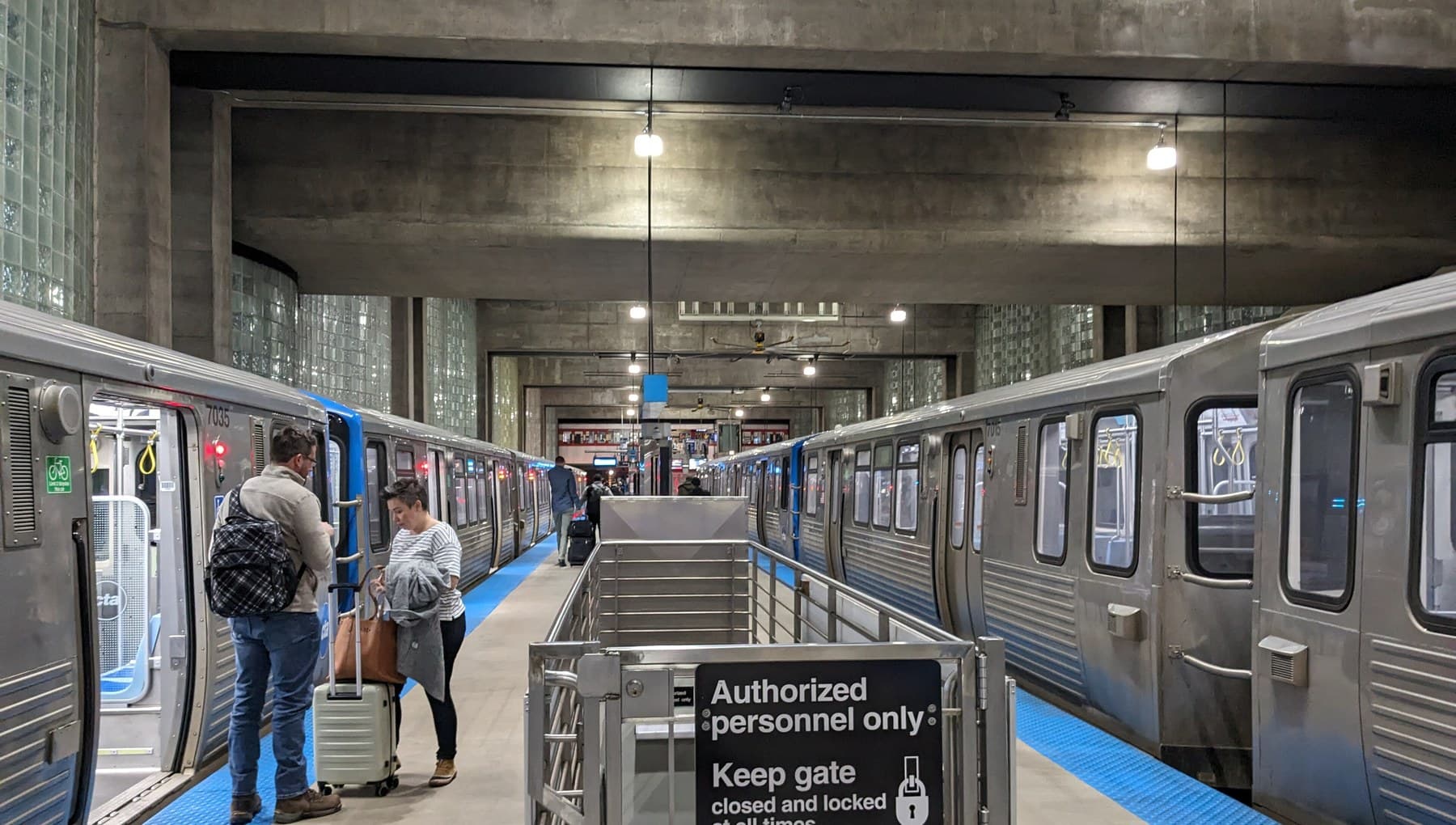
The station sits in the lower level concourse and connects directly to Terminals 1, 2 and 3. From any of those three you follow signs reading CTA Trains or Trains to City, and the CTA states the walk from baggage claim takes under ten minutes.
Terminal 5, which is where most international arrivals land, is the exception and the one worth knowing before you land. It has no direct connection. You follow signs to the Airport Transit System, ride it to Terminal 2, get off, and then pick up the same CTA Trains signs. The ATS is free. There is no Terminal 4.
Once aboard, every train from O'Hare runs through downtown on its way to Forest Park, so there is no wrong platform and no decision to make. The first Loop station is Clark/Lake, which is the sixteenth stop, and Washington, Monroe, Jackson and LaSalle follow it.
If you are taking a car instead, the split is the thing to know in advance. Taxis are on the lower level curb, directly outside baggage claim at every terminal, so you walk out of the door and they are there. Rideshare is not: pickup is on the upper level at Terminals 2 and 3 only, at poles marked 2A to 2G in orange and 3G, 3H, 3J and 3K in green. Black car pickups stay on the lower level. That means the cheaper car option is the one that makes you go upstairs with your bags.
The airport publishes a live taxi wait time at the top of its taxi page, which is worth a look while you are still at the carousel. It also warns, in its own words, not to accept rides from drivers away from the cab stand or on the departures level.
07When a car is worth the money
There are four situations where we would not send someone to the train, and none of them is about speed. Arriving with more luggage than hands. Travelling with small children at the end of a long flight. A hotel that is a genuine walk from any station, which in practice means River North above Chicago Avenue or anywhere in the South Loop east of State. And landing in the small hours, when the train still runs but you have no appetite for a fifteen-minute wait and a walk at the other end.
For the first three, a taxi from the stand is the simplest answer and costs what section 04 says it costs. The case for booking ahead is narrower and it is not financial: you are paying a premium over the meter to know the number before you land and to have someone waiting with your name on a board rather than joining a queue.
The only fixed price in this comparison
Private arrival transfer, O'Hare to any Chicago address
5.00 · 4 reviews
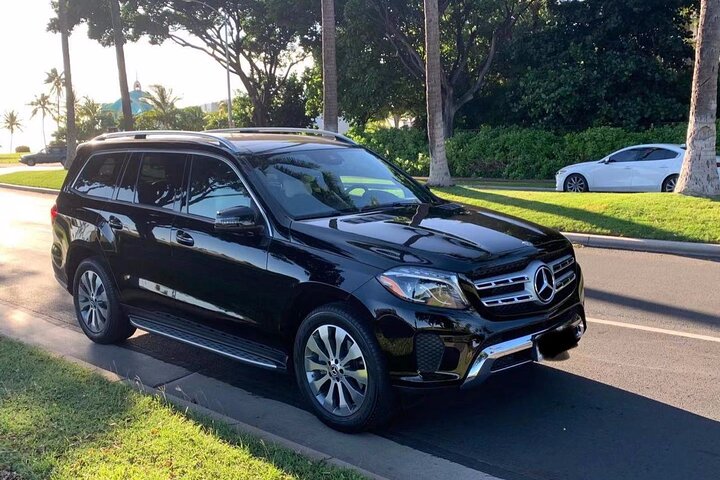
Worth being blunt about what this is. At $74 for one passenger it costs more than a metered taxi, which we put at $56 to $67 for the same trip, so it is not the way to save money. What it buys is certainty: a price agreed before you fly, all fees and taxes included, flight tracking, and a driver at the meeting point in the arrivals hall holding a board with your name. It is priced per vehicle rather than per head, which is what makes it competitive for four or more people with luggage, and there is a cheaper option for arrivals between 1am and 4am that drops the meet-and-greet and collects you from the airport parking instead. The one thing we would hold against it: four reviews is almost no evidence, and a five-star average over four reviews tells you very little.
$73.76 from
Full refund if cancelled 24 hours ahead. Nothing back inside 24 hours.
Check the price for your dateWhatever you book, the comparison to keep in mind is the one this page opened with. The gap between the train and any car is not twenty dollars, it is about fifty, and on a four-day trip the round trip difference is roughly the price of the architecture cruise.
08Questions people actually ask
How much does the train cost from O'Hare to downtown?
Five dollars, and only from O'Hare: the same ride from any other station is $2.50. The airport premium applies to the full fare only, so reduced fare stays at $1.25 and student fare at $0.75. Two things can change that five. A 1-Day CTA/Pace Pass also costs $5 and covers unlimited rides for 24 hours from first use, so paying the single fare buys you one ride at the price of a day. And if you do not have a contactless bank card or a phone to tap, a new Ventra Card costs $5 on top, making the first ride $10; that card fee comes back as travel credit if you register it within 90 days.
How much is an Uber from O'Hare to downtown?
We have not taken one and we are not going to invent a figure. The only number here from a source worth citing is the CTA's own estimate: around $35 to $50, and it states that this surges to $140 or more. Because rideshare pricing is quoted to you before you book, the app on your phone at that moment is a better source than any guide, including this one. What is worth knowing in advance is where you catch it, because it is not where you would expect: see section 06.
Is it safe to take the train from O'Hare to downtown?
We have not measured anything about safety and will not publish a feeling as though it were a finding. What can be stated: the station is inside the airport rather than a walk or a shuttle away, the Blue Line runs at all hours every day, and it is the route the city's own transit agency promotes as the easiest way in. If you want data rather than reassurance, the Chicago Police Department publishes incident data by location and the CTA publishes ridership reports. Neither has been analysed for this page.
How can I get a car service from O'Hare to downtown?
Three ways, in rising order of price. Taxis need no arrangement at all: the stands are on the lower level curb outside baggage claim at every terminal, and the airport warns against accepting a ride from anyone approaching you away from those stands. Limousines and liveries are pre-arranged, with ride boards and a list of licensed companies near the information booths by Door C on the lower level. Booked-ahead private transfers start around $74 and are the only option where the price is fixed before you land.
Is Midway or O'Hare closer to downtown?
Midway, and by a wide margin on both counts. The CTA's own comparison gives Midway 20 to 25 minutes on the Orange Line against 40 to 45 on the Blue Line from O'Hare, and a $2.50 fare against $5. It also puts a Midway taxi at around $25 against around $40 from O'Hare. The one thing O'Hare has that Midway does not is a train that never stops: the Orange Line shuts overnight and is replaced by the N62 Archer bus.
Does the Blue Line run at night?
Yes, and it is the only part of this comparison that genuinely does not stop. The CTA states that Blue Line trains run 24 hours a day, seven days a week, and its own route page lists the hours of operation between O'Hare and Forest Park as service at all times, every day. At three in the morning the choice is a train at the published fare or a road option at whatever the surge happens to be.
Is there work on the line right now?
Yes, until 9 October 2026. The CTA has a modified Blue Line schedule in effect on the O'Hare branch from 10 August to 9 October 2026 because of construction, and states that scheduled gaps between trains may grow by an average of 3 to 4 minutes during non-rush hours and at weekends. It affects how long you wait, not whether the train runs. Check the alert before you travel rather than trusting this paragraph, because it expires.
 Diego Fresno
I spent four days in Chicago in July 2025 and paid for everything myself. I have to be straight about one thing on this page in particular: I did not record how I travelled in from O'Hare, and I have not timed the Blue Line or ridden this route with a taxi meter running. So this page is not built on my trip. It is built on the published rate cards, which for once are the better source anyway, because the fares here are set by ordinance rather than by observation. Where a figure is an estimate, the table says whose estimate it is.
Train fares and Blue Line service read from transitchicago.com on 18 September 2026. Taxi and rideshare pickup arrangements and the $50 average fare read from flychicago.com on the same day. Meter rates from the City of Chicago BACP rate card effective 1 July 2026, dated 22 April 2026. Driving distance measured with OSRM on 18 September 2026. Not verified: any Uber or Lyft fare, because none was measured; train frequency, which the CTA does not publish on the pages used here; and anything at all about safety. The photograph on this page is not our own: it is from Wikimedia Commons and credited beneath it.