
Short answer
- The 3-Day pass is $15 and three 1-Day passes are $15. The saving is $0.
- The 7-Day is $20, which is what four 1-Day passes cost. From day 5 it is strictly cheaper than buying days singly.
- Landing at O'Hare, the single ride costs $5 and the day pass costs $5. The pass is free.
- Transfers are free for up to 2 additional rides within 2 hours, so two rides are often one fare and the usual break-even sum is wrong.
- A Ventra Card costs $5 and Ventra says the fee comes back as transit value when you register it. You may not need one: tapping your own card works.
01The short version
Staying one to three days: buy day passes as you go, or the 3-Day if you prefer not to think about it. They cost the same. Staying four or more: the 7-Day, which is never worse and is cheaper from day 5.
And if you are landing at O'Hare, buy the day pass before you tap in. The single ride from that station costs exactly what the pass costs.
02What a pass costs by length of trip
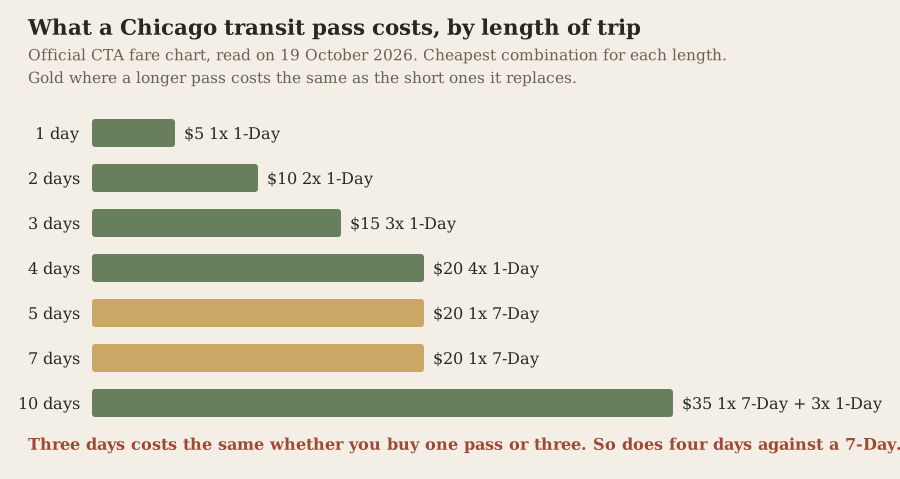
Here is the cheapest combination of CTA passes for every trip length up to ten days, worked out from the official fare chart rather than estimated.
Every CTA pass, and what it works out at per day
| Pass | Price | Per day | Reduced fare |
|---|---|---|---|
| 1-Day CTA/Pace Pass | $5 | $5.00 | Not published |
| 3-Day CTA/Pace Pass | $15 | $5.00 | Not published |
| 7-Day CTA/Pace Pass | $20 | $2.86 | Not published |
| 30-Day CTA/Pace Pass | $75 | $2.50 | $35 |
Read from the CTA's fare chart on 19 October 2026. The chart states it has been in effect since 20 February 2023, which is worth knowing: these are not figures that changed last week. The two highlighted rows are the ones where buying longer saves nothing.
The 3-Day pass is $15 and three 1-Day passes are $15. There is no discount for buying three days at once. The 7-Day is the same story at four days: $20 either way, except the 7-Day leaves three days on the table that you may or may not use.
Where the passes do earn their keep is past that. The 7-Day works out at $2.86 a day against $5 for buying singly, and the 30-Day at $2.5, which is the price of one single train ride per day.
03The three things that cost $5
Google lists why does CTA charge $5 among the questions people ask about Chicago transit, and the reason it gets asked is that three different things cost exactly five dollars, and a visitor meets them in three different places.
Three fives, and only one of them is a pass
| What | How much | What happens to it |
|---|---|---|
| 1-Day CTA/Pace Pass | $5 | Unlimited rides for 24 hours from first use |
| Single 'L' ride starting at O'Hare | $5 | A premium charged on entry at O'Hare. Every other station is the standard fare. |
| A physical Ventra Card | $5 | Refunded as transit value when you register it |
Fares from the CTA chart and the card fee from ventrachicago.com, both read on 19 October 2026. The two highlighted rows are the pair that catches people out, because they are both charged at the airport within a minute of each other.
The two highlighted rows are why a trip can start with a ten dollar charge. Buy a Ventra Card at O'Hare and take a single ride and you have paid $10: five for the card and five for the journey. Buy the card and load a day pass instead and you pay the same $10, except now the rest of the day is included. The rest of that journey, including what you actually wait at three in the morning, is on our guide to getting in from O'Hare.
And you may not need the card at all. The CTA lists a contactless bank card or a phone as ways to pay the same fares. Ventra states the card fee is "$5.00 one-time Ventra Card purchase fee is immediately refunded as transit value upon registration", so registering it turns the five dollars back into travel. Read on 19 October 2026.

The alternative, for scale
Private transfer, Midway to downtown
3.48 · 54 reviews
For completeness, because some trips do not suit a train: a private car from Midway starts at $50, which is ten times the day pass and twenty times a single ride. It makes sense with luggage, small children or a late arrival, and not otherwise. Read its rating before you book: 3.48 from 54 reviews is the lowest score of anything in our Chicago catalogue, and the operator field on the product record reads Elife Las Vegas, which is not a Chicago name.
04Free transfers, and why the easy sum is wrong
Most advice about Chicago passes says a day pass pays for itself in two rides, because $5 divided by $2.5 is 2. That is arithmetic, and it is wrong, because of one line on the fare chart.
Up to 2 additional rides within 2 hours, free. Full, reduced and student fares alike.
So two rides are usually one fare. It is why the easy sum is wrong: two rides inside the same two-hour window are one fare, not two, so a pass has to beat separate journeys rather than separate vehicles.
In practice that means a day pass starts paying when you make three or more separate outings, not three journeys. A morning out, an afternoon back and an evening somewhere else is the shape that beats it. Two trips to the same place and home is usually not.
What each way of paying costs, and what it includes
| How you pay | 'L' | Bus | Transfers |
|---|---|---|---|
| Ventra account or contactless card | $2.5 | $2.25 | Free, up to 2 within 2 hours |
| Cash at the farebox | Not accepted | $2.5 | None |
| Any unlimited pass | Included | Included | Not needed |
Read from the CTA's fare chart on 19 October 2026. The highlighted row is the one to avoid: cash costs more per ride, is not accepted on the 'L' at all, and buys no transfer.
Cash is the expensive way to do this twice over. It costs $0.25 more per bus ride, it does not work on the train, and it buys no transfer, so a journey with one change costs $5.00 instead of $2.25.
05Questions people actually ask
How much is a CTA day pass in Chicago?
$5 for 24 hours from first use, unlimited on CTA trains and buses and on Pace. The 3-Day is $15, the 7-Day $20 and the 30-Day $75, or $35 at the reduced fare. Read from the CTA's own fare chart on 19 October 2026; that chart states it has been in effect since 20 February 2023.
Is the 3-Day CTA pass worth it?
Not against buying day passes, no. The 3-Day costs $15 and three 1-Day passes cost $15. The saving is $0. The only thing it buys you is not having to buy a pass on two more mornings, which is worth whatever that is worth to you, and nothing else.
Which Chicago transit pass is cheapest for a four-day trip?
The 7-Day, and it is a tie rather than a saving: $20 against $20 for four 1-Day passes. Same money, three days you will not use. From the fifth day onwards the 7-Day is strictly cheaper than buying days one at a time, so there is no length of trip at which four separate 1-Day passes makes sense.
Why does CTA charge $5?
Because three different things cost $5 and people meet them in different places. The 1-Day pass is $5. A single 'L' ride starting at O'Hare is $5, which is a premium charged at that station only. And a physical Ventra Card costs $5 to buy. The third one comes back: Ventra states that the "$5.00 one-time Ventra Card purchase fee is immediately refunded as transit value upon registration".
How much is a Ventra card in Chicago?
$5, and Ventra's own page says the fee is "$5.00 one-time Ventra Card purchase fee is immediately refunded as transit value upon registration". So in practice the card is free if you register it, and $5 if you do not. You may not need one at all: a contactless bank card or a phone tapped at the reader pays the same fares without buying anything.
Do I need a Ventra card to ride the L?
No. The CTA lists contactless bank cards, mobile wallets, a Ventra Card, a Ventra Ticket and cash as ways to pay. Tapping your own card or phone charges the same fares as a Ventra Card, so the card is a convenience rather than a requirement. Cash is the exception and it is worse: it only works on buses, it costs more, and it buys no transfer.
How much does a bus fare cost in Chicago?
$2.25 if you tap a Ventra account or a contactless card, and $2.5 if you pay with cash at the farebox. The 0.25 difference is not the real cost of paying cash: That makes a cash journey with one change $5.00 against $2.25 tapped.
Are transfers free on the CTA?
Yes, and this is the detail that breaks most of the arithmetic you will read elsewhere. The CTA gives you up to 2 additional rides within 2 hours at no charge, on full, reduced and student fares alike. So a journey involving a bus and then a train is one fare, not two. A day pass has to beat separate journeys, not separate vehicles.
Is it cheaper to take the train from O'Hare or buy a pass?
They cost the same, so take the pass. A single 'L' ride from O'Hare is $5 because of the premium charged at that station, and a 1-Day pass is also $5. The CTA says so itself in a footnote on its fare chart: use an unlimited pass to board at O'Hare for no additional charge. Buying a single ride at the airport is paying the same money for one journey instead of a day of them.
 Diego Fresno
I used the 'L' in Chicago in July 2025 on a contactless card without thinking about any of this, which is the cheapest thing most visitors do by accident. The figures here are the CTA's own fare chart, and the comparisons are arithmetic on those figures rather than advice: the 3-Day saving is zero because $15 equals $15, not because I think the pass is bad value. The one thing I would have got wrong without reading the chart line by line is the transfer rule, which quietly changes what a ride means.
All fares, pass prices, the transfer allowance, the O'Hare premium and the cash-on-bus surcharge read from transitchicago.com/fares on 19 October 2026; that chart states it has been in effect since 20 February 2023. The Ventra Card fee and its refund wording from ventrachicago.com the same day, quoted exactly. The cheapest combination for each trip length is computed from those published prices by testing combinations, not estimated. Transfer price, rating, review count and operator from the Viator product record, with the operator taken from the record rather than the title. NOT verified and therefore absent: whether any time limit applies to the Ventra Card refund, which Ventra's current page does not mention at all, so register the card promptly rather than assuming there is no deadline; and the reduced-fare price of the 1-Day, 3-Day and 7-Day passes, which the chart does not give.